

Read Time: 9 min
Summer in Pennsylvania is prime riding season. From cruising down Route 30 to exploring the winding backroads of Chester County, there is nothing quite like the freedom of two wheels. However, the intense mid-summer heat does more than just test your endurance; it puts an incredible amount of stress on your motorcycle’s vital fluids.
Mid-season is when minor performance hiccups turn into major mechanical issues. High operating temperatures accelerate chemical breakdown, reducing the lubricating, cooling, and hydraulic efficiency of your bike’s fluids.
Whether you are prepping for a long road trip or keeping up with your routine maintenance, understanding the “big four” motorcycle fluids is essential to protecting your investment and ensuring your safety. Here is your complete guide to motorcycle fluid exchanges, why they matter, and how the summer heat impacts them.
TL;DR / Quick Summary
Pennsylvania’s intense summer heat accelerates the chemical breakdown of your motorcycle’s vital fluids, leading to engine wear, reduced braking power, and poor handling. Regular fluid exchanges are critical to maintaining safety, performance, and passing state inspections.
Key Takeaways:
- Engine Oil: Needs changing every 3,000–5,000 miles as high heat rapidly degrades viscosity.
- Coolant: Requires flushing every 2 years to prevent overheating and internal system corrosion.
- Brake Fluid: Must be exchanged every 2 years to prevent moisture absorption and dangerous brake fade.
- Fork Oil: Needs replacement every 10,000–15,000 miles to maintain front-end stability and control.
- PA Inspection: Spongy brakes or active fluid leaks will result in an automatic PA State Inspection failure.
1. Engine Oil: The Lifeblood of Your Engine
Your engine oil has a massive job: it lubricates moving parts, helps dissipate heat, and cleans away internal contaminants. Unlike passenger cars, many motorcycles use a “wet clutch” system, meaning the engine oil also lubricates the clutch and transmission. This dual-duty role subjects the oil to extreme shear forces.
The Summer Heat Factor
Pennsylvania’s humid, high-temperature summer days cause engine oil to thin out faster. When oil gets too hot, its viscosity breaks down, reducing its ability to form a protective barrier between metal components. This leads to:
- Increased engine wear and friction.
- Rougher gear shifting.
- Accelerated oil consumption.
When to Exchange
While a standard rule of thumb is to get a motorcycle oil change every 3,000 to 5,000 miles (or at least once per season), high-heat summer riding can shorten this interval. If your oil looks dark black, smells burnt, or feels gritty, it is time for a fresh change and a new oil filter.
2. Engine Coolant: Preventing Mid-Summer Boilovers
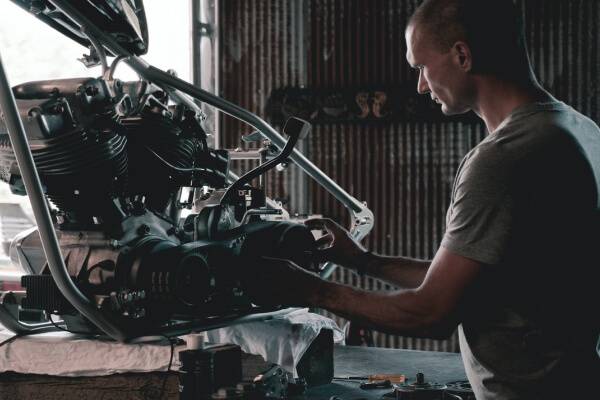
If you ride a liquid-cooled motorcycle, your coolant is the only thing standing between a smooth ride and a catastrophic engine meltdown. Coolant circulates through the engine block, absorbing heat and releasing it through the radiator.
The Summer Heat Factor
When you are stuck in traffic on a hot afternoon, your radiator relies heavily on the coolant’s chemical integrity to prevent boiling over. Over time, coolant loses its anti-corrosive properties. This allows rust, scale, and mineral deposits to build up inside your cooling system, clogging narrow passages and reducing heat transfer.
When to Exchange
A professional motorcycle coolant flush is typically recommended every two years. Flushing the system removes old, degraded fluid and clears out performance-robbing deposits, ensuring your cooling system can handle Pennsylvania’s peak summer temperatures without breaking a sweat.
3. Brake Fluid: Your Most Critical Safety Component
Your motorcycle’s braking system relies on hydraulic pressure. When you squeeze the front brake lever or press the rear pedal, brake fluid transfers that force directly to the calipers.
The Summer Heat Factor
Most motorcycles use glycol-based brake fluid (DOT 3, 4, or 5.1), which is hygroscopic, meaning it actively absorbs moisture from the air.
- As moisture enters the system, it lowers the boiling point of the brake fluid.
- Under heavy braking on hot summer days, the water inside the lines can boil and turn into vapor.
- Because vapor is compressible (unlike liquid), this causes a terrifying phenomenon known as brake fade or a “spongy” brake lever, drastically reducing your stopping power.
When to Exchange
To maintain crisp, reliable braking performance, a brake fluid exchange should be performed every two years, regardless of mileage. If your brake fluid looks amber or dark brown instead of clear/light yellow, it has absorbed dangerous levels of moisture and needs immediate service.
During an official Pennsylvania safety inspection, your motorcycle’s braking system is thoroughly evaluated for roadworthiness. A motorcycle will fail inspection if there is any noticeable brake fade, excessive lever travel, or “sponginess” when pressure is applied. Additionally, inspectors check for any metal-on-metal contact between pads and rotors, and any active fluid leaks in the master cylinder, calipers, or brake lines will result in an automatic rejection. Read more about motorcycle brake maintenance here.
4. Fork Oil: The Key to Smooth Handling and Control
Often overlooked, fork oil lives inside your front suspension. It acts as both a hydraulic damping medium to control suspension movement and a lubricant for the internal seals and bushings.
The Summer Heat Factor
As your front forks compress and rebound thousands of times over uneven Pennsylvania roads, the fork oil is subjected to friction and heat. Over time, the oil shears down, losing its viscosity. Additionally, microscopic metal shavings and dirt bypass the fork seals, turning the oil into an abrasive slurry that wears down internal components.
- Symptoms of worn fork oil: A harsh or excessively bouncy front end, poor cornering stability, front-end “dive” under braking, or visible oil leaking down your fork tubes.
When to Exchange
Most manufacturers recommend a fork fluid exchange every 10,000 to 15,000 miles or every two years. Fresh fork oil restores your bike’s original handling characteristics, improves tire contact with the road, and protects expensive suspension components from premature wear.
What You Can Handle vs. When to Call a Pro
While some basic maintenance tasks are highly rewarding to tackle in your own garage, others require specialized tools and safety protocols to ensure your bike remains roadworthy.
Tasks Most Riders Can Do
- Checking Fluid Levels: Inspecting the engine oil sight glass or dipstick, coolant overflow tank, and brake fluid reservoirs weekly.
- Topping Off Fluids: Adding small amounts of matching coolant or oil if levels are slightly low (always consult your owner’s manual for exact specifications).
Tasks for Confined DIYers
- Basic Oil Change: Replacing engine oil and the oil filter. This requires a torque wrench, oil filter wrench, oil catch pan, and a safe way to dispose of used oil at a local recycling center.
When to Call a Professional
- Brake Fluid Exchanges: Bleeding ABS-equipped braking systems often requires specialized electronic scan tools to cycle the ABS pump and clear trapped air.
- Coolant Flushes: Disposing of toxic ethylene glycol coolant safely and ensuring no air pockets are trapped in the cooling system (which can cause localized engine hot spots).
- Fork Fluid Service: Requires specialized front-end stands, fork spring compressors, seal drivers, and precise oil level measurements (measured in millimeters from the top of the collapsed fork tube).
- Red flags requiring immediate professional attention: Any visible fluid leaks near brake calipers, oily residue on fork stanchions, or an engine temperature warning light.
Common Motorcycle Fluid Mistakes to Avoid
1. Using Passenger Car Engine Oil
- What people do wrong: Pouring standard automotive engine oil into their motorcycle.
- Why it’s a problem: Passenger car oils contain friction modifiers designed to maximize fuel economy. In a motorcycle with a wet clutch, these modifiers will coat the clutch plates, causing the clutch to slip, overheat, and eventually fail.
- The right approach: Always use oil specifically formulated for motorcycles (typically carrying JASO MA or MA2 certifications for wet clutches).
2. Mixing Different Types of Brake Fluid
- What people do wrong: Mixing glycol-based DOT 4 fluid with silicone-based DOT 5 fluid.
- Why it’s a problem: DOT 4 and DOT 5 fluids are chemically incompatible. Mixing them causes the fluid to gel, completely clogging your brake lines and causing total brake failure.
- The right approach: Check the reservoir cap to verify the required fluid type (usually DOT 4) and never mix glycol and silicone fluids.
3. Ignoring the Fork Oil
- What people do wrong: Assuming fork oil lasts the lifetime of the motorcycle.
- Why it’s a problem: Degraded fork oil ruins your suspension damping, leading to poor tire contact, unstable cornering, and accelerated wear on expensive internal fork components.
- The right approach: Treat fork oil as a wear item and exchange it every two years or 15,000 miles.
Conclusion
Maintaining fresh, clean fluids is the single most effective way to protect your motorcycle’s engine, ensure your safety, and guarantee a smooth ride through the Pennsylvania summer. From the critical hydraulic pressure of your brake lines to the lubricating barrier of your engine oil, every fluid plays a vital role in how your bike performs.
At Barry’s Collision Repair of Parkesburg, we have been serving our local community with integrity and generational craftsmanship since 1973. In addition to our premier collision and paint services, we are an authorized PA State Inspection station equipped to handle major mechanical repairs, tire replacements, and comprehensive fluid exchanges for motorcycles. If you are noticing a spongy brake lever, a bouncy front end, or simply want to ensure your bike is ready for the road, let our expert team take care of it. To see a complete list of the services we offer, visit our website.
Serving Parkesburg, Coatesville, Atglen, Christiana, Gap, and the surrounding Chester County region.
Schedule Your Motorcycle Service Today
Visit Our Shop: 4073 Lower Valley Rd, Parkesburg, PA 19365
Call Us Directly: +1 (610) 593-2775
Explore Our Services: barryscollisionrepair.com/services/
Frequently Asked Questions
How often should you change motorcycle brake fluid?
Motorcycle brake fluid should be exchanged every two years, regardless of how many miles you ride. Because brake fluid is hygroscopic, it continuously absorbs moisture from the air, which lowers its boiling point and can lead to dangerous brake fade under heavy use.
What causes a motorcycle clutch to slip after an oil change?
A slipping clutch can be caused by using passenger car engine oil instead of motorcycle-specific oil. Passenger car oils contain friction modifiers that reduce friction to save fuel, which causes the plates in a motorcycle’s wet clutch system to slip. Always use JASO MA or MA2 certified oils.
Can you mix different brands of motorcycle coolant?
While you can technically mix brands of the same coolant type, you should never mix different coolant technologies (such as Inorganic Acid Technology [IAT] and Organic Acid Technology [OAT]). Doing so can cause chemical reactions that form a thick sludge, clogging your radiator and water pump.
Why does my motorcycle front end dive excessively when braking?
Excessive front-end dive is a classic symptom of worn-out or low fork oil. Over time, fork oil loses its viscosity and damping properties, allowing the front suspension to compress too quickly under braking. Exchanging the fork oil restores proper hydraulic damping and control.
Will a fluid leak cause a motorcycle to fail PA State Inspection?
Yes. Under Pennsylvania inspection regulations, any active fluid leaks, including engine oil, coolant, brake fluid, or front fork oil, will result in an automatic inspection failure. Fluids leaking onto tires or brake rotors present an immediate safety hazard.
Sources
- Pennsylvania Department of Transportation (PennDOT) — Official motorcycle safety inspection regulations and brake system requirements.
- Lubrizol JASO (Japanese Automotive Standards Organization) —More information about JASO Oils